Industrial Applications
We design and build custom systems for industrial and pharmaceutical use, with certified reliability and quality.
Applications
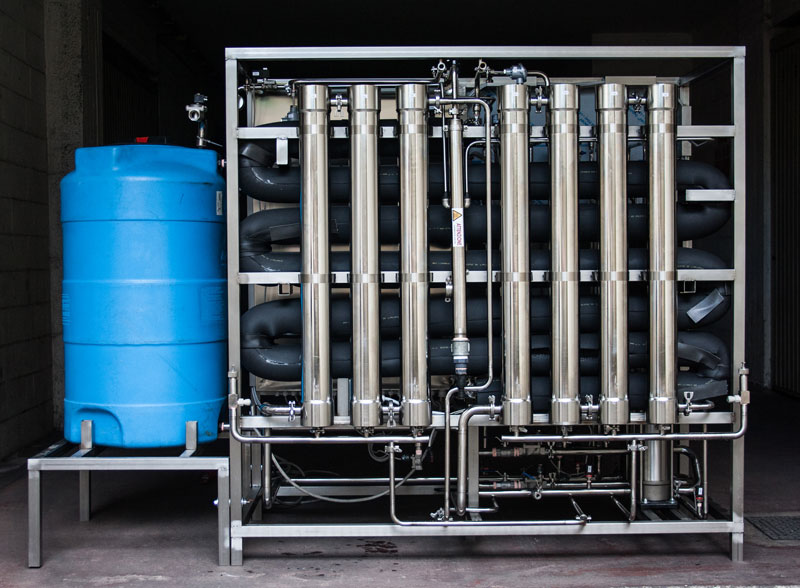
Puretech designs and builds water treatment systems for industrial and technological use. We consider not only the purification process itself, but also any storage requirements, distribution to the various points of use, and the sanitisation systems for pipework and equipment.
Our knowledge of water treatment processes and the technological expertise developed in the medical sector enable Puretech’s technical department to design systems for the widest range of applications, from “simple” drinking water production to the highest standards of the pharmaceutical sector. We use the broadest range of technologies to bring water into compliance with the strictest standards, such as Purified or Ultrapure water.
To build systems of this kind, in which water must meet all the characteristics required by the client, we propose a variety of treatments. These vary considerably depending on the properties of the available feed water but generally include the following.
Chemical conditioning
Puretech is always ready to make its specialists available to identify the chemical treatment best suited to the user’s needs.
By adding selected and certified chemical products, water can be made suitable for the widest range of technological applications, especially those involving heating processes. This prevents corrosion and scaling of pipework and machinery, preserving their performance over time. The same technology also counters bacterial growth, safeguarding the health of anyone who comes into contact with the water.
Automatic filtration
The water we use every day may contain impurities which, if not controlled, can cause a range of problems for users, both in technological applications and for human use and consumption.
Puretech offers efficient automatic filtration systems designed both to remove chemical contaminants such as iron, vanadium and arsenic, using filters with different filter-bed technologies, and to remove solid and colloidal particulate pollution, using cartridge filters or complex self-cleaning systems designed for high flow rates.
Ultrafiltration
For several years, ultrafiltration with physical-separation membranes has been a cost-effective and reliable technology for the purification and sterilisation of surface water to drinking standard, and for the tertiary treatment of municipal and industrial wastewater.
Ultrafiltration systems designed by Puretech remove particles as small as 0.001–0.1 µm, such as viruses, from liquids, while also achieving significant energy savings compared with conventional clariflocculation, filtration and disinfection treatment.
Ideal for achieving a very high degree of water purity and for maintaining the high disinfection standards required by industrial processes, such as those of the food, metalworking, pharmaceutical and cosmetics industries, ultrafiltration is also increasingly used as an effective barrier against Legionella.
Reverse osmosis demineralisation
The principle underlying reverse osmosis demineralisation is the passage of water through a semi-permeable membrane in the direction opposite to the natural one, by applying an operating pressure. This generates two solutions: one with a high salt concentration and the other highly diluted.
This simple treatment method, technologically reliable and efficient to the highest standards, removes 99% of the particles present in water, such as bacteria, viruses and impurities, producing chemically and bacteriologically pure water.
Puretech builds state-of-the-art reverse osmosis systems, ideal for producing purified water, ultrapure water or water that simply complies with drinking water standards, according to the client’s requirements.
Puretech’s modern reverse osmosis systems feature a single management and control panel mounted on the machine; all components in contact with water are made of materials always suited to the specific application, and all components are exposed to facilitate maintenance.
Ozone disinfection
Ozone disinfection is among the most advanced systems that Puretech offers to purify water to the point where it can no longer harm the people, animals and plants that come into contact with it.
Thanks to its high oxidation potential, ozone oxidises the essential components of bacterial cells, degrading them until they are destroyed. For this reason, ozone disinfection is not only a technologically innovative process but also a fully environmentally sustainable one.
The simplicity and non-invasive nature of the technique have led to the wide use of ozone disinfection in the pharmaceutical and eco-cosmetics sectors. Puretech can offer solutions at several technological levels depending on the type of application, from well-established systems that produce ozone from air to more modern systems that produce ozone directly from water.
Softening
Water in general, and mains water in particular, contains varying amounts of calcium and magnesium salts. When subjected to heating processes, these salts can cause scaling, with a consequent loss of thermal efficiency in the systems they come into contact with.
Puretech supplies increasingly innovative water softening systems, essential for ensuring the full usability of water networks and points of use, and for meeting the quality standards of the electronics, food and pharmaceutical industries.
Dechlorination
Removing the excess chlorine used to disinfect drinking water is essential to make it usable for consumers and acceptable for industrial use.
For this reason, Puretech provides its clients with the most efficient activated carbon filtration systems and dosing systems, such as metabisulphite dosing, which keep chlorine levels in water under control and eliminate its negative effects, such as unpleasant tastes and odours and possible damage to body tissues.
Electrodeionisation
For the production of ultrapure water, we offer sophisticated water deionisation systems using continuous electrodeionisation (EDI) units.
Thanks to this technological innovation, Puretech can supply deionised water with a conductivity that meets the highest quality standards, such as those required by the Italian Official Pharmacopoeia (Farmacopea Ufficiale).
A very low concentration of ionic components in the output water is essential for washing and rinsing in semiconductor manufacturing; for production in the pharmaceutical sector, hospitals and research centres; and also for feeding high-pressure steam boilers and for water injection in gas turbines. All this is achieved with minimal electricity consumption and a guaranteed, consistently high quality of the water produced.
Control systems
Drawing on its experience in developing increasingly complex systems, Puretech offers modern equipment for automating water treatment processes. This includes automatic filling systems, centralised system control and advanced sensor systems for real-time monitoring of the physical, chemical and microbiological parameters of water. These ensure a consistently high level of purity over time and make system maintenance and management easier and more efficient.
Processes
Water with purified or ultrapure characteristics is required in many processes. In the pharmaceutical industry, water treatment requires proven specialist expertise to fully meet the quality requirements for producing purified and ultrapure water. Particular attention is paid to design and to the choice of materials: systems must be made of stainless steel or FDA-approved plastic materials.
To build a water treatment system for the industrial and pharmaceutical sectors, Puretech carries out a series of activities aimed at delivering the best possible service:
- the application and the site’s production process are analysed;
- the physical, chemical and bacteriological characteristics of the process feed water are verified, in cooperation with certified and accredited laboratories;
- the condition of existing systems is inspected;
- the suitability of materials and the operating conditions of the system are certified.
Only once all the information needed to carry out an appropriate feasibility study and develop the design has been gathered does the actual production of the systems begin. Systems are pre-assembled and tested at our operational site.